
“Authorized to destroy.”
—Cuban military command to MiG pilots locked into Brothers to the Rescue plane in 1996. FAA transcript.

22 mayo 2026
Hola y welcome back to CubaCurious.
Gracias for being here.
Cuban activists awoke this Wednesday, as they do every May 20th, to police officers at the door and undercover agents on the corner. They didn’t realize that this May 20th—Cuba’s original Independence Day, eliminated by the revolution after it came to power in 1959—would be different. The U.S. had chosen the date to announce its indictment of Raul Castro and five other former military personnel for the 1996 shutdown of two U.S.-registered Brothers to the Rescue planes.
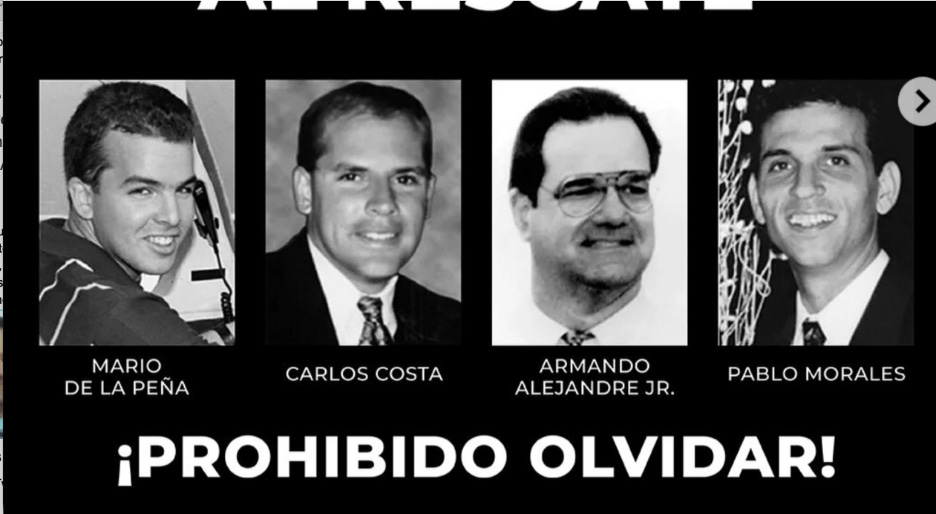
Four men aboard the BTTR Cessnas were killed that February day: Mario de la Peña, 24, Carlos Costa, 29, Armando Alejandre Jr., 45, and Pablo Morales, 29. All but Morales were U.S. citizens. Morales had been rescued by BTTR in 1992, when he escaped Cuba by sea. Floating in the ocean, with the BTTR planes above him, Morales made a promise that if he survived he’d help rescue other fleeing Cubans. And so he did.
Average Cubans and activists celebrated the indictments online, in interviews, and worldwide outside of Cuba. Many appreciated the timing. Maybe next year they’d be able to celebrate May 20th in freedom.
If they found themselves thinking that way, they are practicing the post-revolutionary Cuban tradition of “será esto el final?” Could this be the end of the dictatorship?
But Castro’s Cuba was designed against counter revolutions, invasions—even the spark of dissent. Cuba wasn’t going to let four pesky exiles in propeller planes threaten its “perfect model” in 1996, or ever.
Today, I read again the FAA transcript of the communication between the two Cuban MiGs and Cuban central command on 24 February 1996, the day of the shoot down. I’d missed something the first time around. The MiG-29 pilot had wanted to do a pass around the “small aircraft” he’d been sent out to find, presumably in warning. The MiG-23 pilot responded with, “If we give it a pass it will complicate things.”
Complicate what? The shoot down they’d been sent to execute, it seems.
“Fire,” the command center ordered.
An exchange followed between the pilots and the command center in which the center gave the order to “fire” or said “authorized to destroy,” an additional five times before the MiG-29 launched an air-to-air missile at the first BTTR Cessna. Pilot Carlos Costa and the former Cuban rafter turned co-pilot, Pablo Morales, both 29 years old,. were killed instantly.
The MiG-29 pilot screamed repeatedly, “We gave him balls. . . We took out his balls.”
“This one won’t fuck around anymore,”* the MiG-23 pilot said.
Seven minutes later the pilot of the MiG-29, who had wanted to do the pass on the first Cessna, launched another missile at a second BTTR Cessna, killing 24-year-old pilot Mario de la Peña and passenger/copilot and Armando Alejandre, 45.
I remember Cuba’s shoot down of the BTTR planes very well. I was a young mother and, between diaper changes and Barney episodes, I’d been following BTTR’s search and rescue missions aiding Cuban refugees in the Florida Straits. I knew the group had also provoked the dictatorship, crossing their planes at times into Cuban airspace.
BTTR’s leader would identify his plane to Cuban air traffic controllers as he knowingly approached Cuban airspace. Jose Basulto didn’t consider himself a foreigner when re-entering Cuba, he said in a 1999 interview for the University of Miami’s Institute for Public History. “And that sovereignty belongs to the people of Cuba, and not to the ruler, Fidel Castro in this case, and I’m not infringing on the sovereignty of my country, namely Cuba, by being there. . .”
You can argue that BTTR bears a significant responsibility for the tragedy. You can say that Cuba had a right to complain about these provocations and that the U.S. could have done more to stop BTTR. But there is no justification for MiGs incinerating four human beings over international waters without radioing them first or attempting to escort them farther out to sea.
That’s what a UN report concluded in June 1996 after a four-month investigation of the tragedy, citing international laws barring countries from firing on civilian planes even when they are inside their own airspace—which the BTTR planes were not. The UN did not entirely condemn Cuba for the shoot down, but it passed a resolution affirming that the use of weapons against civilian aircraft was "incompatible with elementary considerations of humanity . . .”
Cuban officials were unrepentant, boasting they would defend the homeland against terrorism again and again. Castro condemned the U.N. report, saying the investigation was a farce, corrupted by U.S. influence. Today, Cuba still insists the planes were inside its airspace and that any country would have done the same thing.
This Wednesday, Cuban Carlos Fernández de Cossío, Cuba’s foreign relations vice minister, ferociously defended the shoot down on Cuban state-controlled television. He described BTTR as a terrorist threat and asserted, falsely, that the planes had been inside Cuban airspace. He also said, again falsely, that “on a number of occasions” the U.S. had shot down civilian aircraft that entered its airspace. Unsurprisingly, the host did not challenge Mr. Cossío on that whopper.
In Miami Cuban Americans celebrated the “end of impunity of the henchmen” that have ruled them for 67 years, as Cuban American Orlando Gutiérrez Boronat, spokesperson for the Cuban Democratic Directorate, said at one rally. But it’s a long road to justice for the families of the victims.
Although their long-awaited dream of justice has been revived, some described it as bittersweet. They are reliving some of the worst days of their lives. Hearing the audio of Raul Castro giving the order to execute their relatives, part of the evidence the U.S. says it has, will be devastating, I’m sure.
In the end, justice for Mario, Carlos, Armando, Pablo, and their families is impossible. However, holding the members of the Cuban Armed Forces who were directly responsible for their executions is at least a beginning. Finally.
Hasta la semana que viene,
Ana
*The English transcript says “bother,” but the Spanish says joder.
Cuban Treat of the Week
Here’s a peaceful view of the mogotes of Viñales, in Pinar del Río Province. I took the photo on my last trip to Cuba. The limestone hills are old, old, old. Jurassic old. Rounded by time, softened by Cuba’s heat and humidity. They seemed to melt in the haze that day.
The valley is one of Cuba’s main tobacco growing regions. It’s a 3-hour from of Havana and a designated UNESCO World Heritage Site. I’m sure you can see why the world needs this green and blue beauty right now—always.

Not a surprise The U.N did not outright condemn. The U.N is a toothless failure.
This is a beginning and now more people will learn of this and know what happened.
Muy triste y horrible lo que hicieron. I remember that distinctly because that was the day (Feb 24) I arrived in the US. Nobody knew anything in Cuba at the time I left, but when I got to San Diego, my husband's friends were all asking about it. I called my mom, who didn't know anything either. They kept it quiet for several days there. ¡Pero lo bueno es que ya viene llegando la libertad!